Example AI workflow with human oversight



Team online now
Detailed answers to the questions law firm operations leaders, managing partners, and legal technology evaluators ask before deploying AI in legal workflows.
The most impactful AI applications in legal services today are operational, not speculative. Firms are using AI to extract structured data from incoming documents (contracts, filings, client submissions), summarize case files so attorneys review briefings rather than raw documents, validate whether required case materials are present and flag specific gaps, generate repeatable legal documents from approved templates with conditional clause logic, route new matters to the right attorney based on practice area expertise and current workload, and turn workflow activity into management dashboards that give firm leadership real visibility into operational performance.
The critical distinction is between AI that produces output and AI that connects to action. A model that summarizes a contract is useful. A workflow that reads an incoming contract, extracts key terms and parties, flags non-standard clauses, generates a review brief for the attorney, routes it for sign-off, and files the executed version — that is AI integrated into legal operations.
Zenphi is built for the second type. AI steps (Gemini, GPT-4o, Claude) run as named, governed steps inside structured legal workflows. AI handles the extraction, classification, drafting, and summarization. The workflow handles the routing, generation, approval, and filing. Every AI action is logged. Attorneys stay in control at every point where control matters — client data stays within the firm's Google Workspace environment and never transits external infrastructure outside the configured model connections.
The safest and most effective approach is to embed AI inside structured legal workflows rather than use it as a freestanding tool. Law firms that generate the most value from AI — while maintaining the professional responsibility standards, client confidentiality obligations, and compliance requirements they operate under — share a common architectural approach: AI is applied to clearly defined, bounded tasks (data extraction, summarization, document validation, document generation, workload assignment), with human review gates at every step where legal judgment is required, and a complete audit trail of every AI action.
The risks that arise from unsanctioned AI use in legal contexts — inconsistent outputs, confidentiality exposure, unreviewed drafts reaching clients — are architectural risks, not capability risks. They occur when AI is used outside a governed process rather than inside one. Inside a governed workflow, the AI step has a defined input, a defined output schema, and a defined routing rule for what happens based on what the model produces. Low-confidence outputs route to human review automatically. High-risk flags surface to the supervising attorney before any action is taken.
Zenphi supports this model directly: AI-powered legal workflows with review steps, approval checkpoints, human-in-the-loop gates enforced architecturally, and full execution logging at every step. Client data stays within the firm's Google Workspace environment. The result is AI that improves efficiency without compromising oversight, consistency, or client trust.
Document-heavy and administration-heavy workflows are consistently the best starting points — and also where firms recoup attorney time most quickly. The strongest first candidates are: matter intake and triage (AI reads incoming requests, extracts matter details, classifies practice area and urgency, and routes to the right attorney — eliminating the manual reading and decision-making that slows intake at every firm); case file validation and missing-document follow-up (AI checks incoming files against required document checklists and triggers specific follow-up requests automatically when items are missing); document summarization for review (AI reads contracts, filings, and case documents and generates structured review briefs so attorneys read the summary rather than the entire raw document); legal document generation (NDAs, engagement letters, retainer agreements, and standard filings generated from approved templates with conditional clause logic, routed for approval, and filed automatically); and workload-based assignment (AI matches incoming matters to the right attorney based on expertise, historical matter types, and current caseload).
These are high-friction, high-volume processes where AI can improve speed and consistency without trying to replace legal expertise.
Zenphi is most effective here because AI actions are connected to the actual process around them — routing work, updating statuses, generating documents, triggering follow-ups — rather than producing outputs that someone still has to manually act on. AI handles the interpretation step. The workflow handles everything that follows.
Client communication is one of the most time-consuming and consistent sources of attorney and staff overhead in legal operations — and one of the areas where AI delivers the fastest, most visible improvement. Most client communications in a law firm follow predictable patterns: intake acknowledgments, follow-up requests for missing documents, status updates at defined workflow stages, deadline reminders, document delivery confirmations. Each involves drafting, reviewing, and sending communications that convey structured information in a professional, firm-consistent format — exactly the type of work where AI drafts reliably and humans can review quickly before sending.
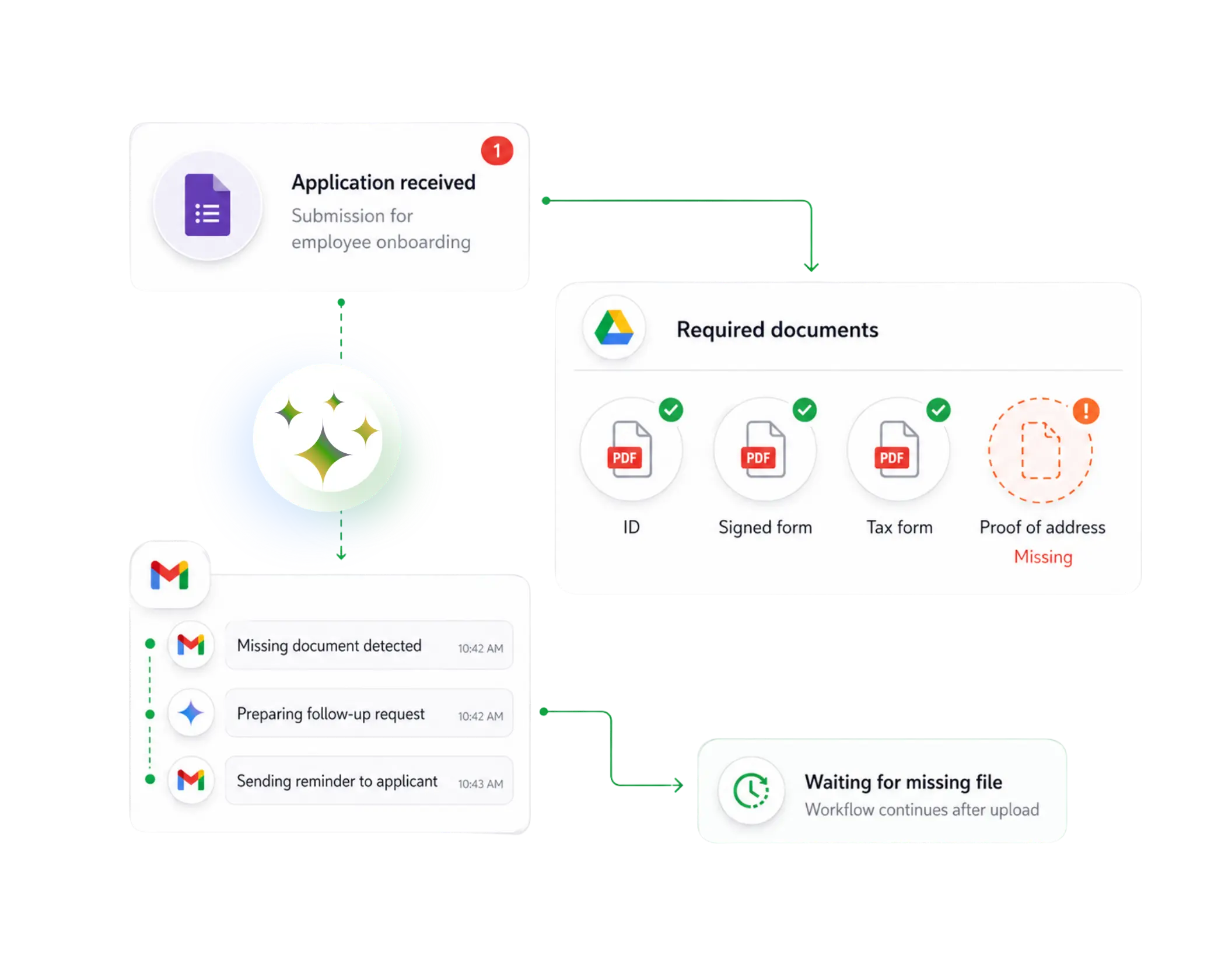
AI-assisted client communication works by connecting communication steps directly to workflow events. When a new matter is received, an intake acknowledgment is generated using the extracted matter details and firm communication guidelines. When a case file arrives with missing documents, a specific follow-up request names the exact missing items — not a generic reminder. When an approval is completed, the client notification is queued for review. When a deadline approaches, a reminder is generated with the relevant matter context.
In Zenphi, every generated communication is tied to the workflow event that triggered it, the data used to generate it, and the reviewing attorney's identity. Communications are consistent, professional, and tracked — without adding to attorney drafting workload. Faster responsiveness, complete communication record in every matter file.
The most important evaluation criterion is not which platform has the most advanced AI model — it is which platform embeds AI most effectively inside the actual legal workflow. Firms that evaluate AI platforms on model capability alone often end up with tools that produce impressive outputs but require someone to manually decide what to do with those outputs at every step. The operational value disappears. The questions that matter most in the evaluation are:
Does the platform connect AI outputs to automated next steps? Routing, generation, filing, notification — or does a human still bridge every gap? Does the platform provide human review gates where legal judgment is required? With the AI output visible alongside the document so the reviewing attorney sees the brief, not just the raw file? Does the platform maintain a complete audit trail of every AI action? Input received, model used, output produced, routing decision followed? Does the platform keep client data within the firm's own environment? Not transiting third-party AI infrastructure? Does pricing scale predictably as document and matter volume grows? Or does per-document, per-matter, or per-user pricing create cost pressure that limits deployment?
Zenphi addresses all five: AI steps are named, governed steps inside structured workflows that connect directly to routing, generation, approval, and filing actions. Human review gates are enforced architecturally. Every AI action is logged at the step level. Client data stays within the firm's Google Workspace environment. Flat process-based pricing means document volume and matter volume don't drive cost increases.
Document workflows — the collection, review, generation, validation, approval, and filing of documents — are still the operational core of how legal work moves. Every matter generates documents. Every document requires some combination of creation, review, routing, approval, execution, and storage. The manual effort in each of those steps — reading documents to find what matters, checking files for completeness, generating standard agreements from templates, routing for approval, chasing signatures, filing with the right structure and permissions — accumulates into the operational drag that limits firm capacity more than any other single factor.
Modernizing document workflows with AI does not change what legal work requires — it changes how the non-judgment steps in that work get handled. AI reads the document so the attorney reads a brief. AI checks the file so the paralegal doesn't check manually. AI generates the NDA so the attorney reviews a draft rather than produces one. AI routes for approval so the workflow manager doesn't track signatures in a spreadsheet. In each case, the legal work requiring expertise and judgment remains human. The operational steps around it become automated.
The practical effect: attorneys work on matters rather than administration, and the firm's throughput increases without proportional headcount growth. Zenphi connects document-related AI actions to the full operational workflow — intake, generation, review, approval, follow-up, and reporting — so modernization applies to the complete document lifecycle rather than to isolated steps that still require manual handoffs.
The most instructive pattern from successful AI implementations in law firms is that they almost never start with firm-wide transformation. They start with a single, high-volume, high-friction workflow — one that everyone agrees is slow and manual — and automate it completely before expanding. The firms that get the best results pick one specific operational bottleneck (matter intake, document validation, engagement letter generation, contract review summarization) and build a workflow that handles it end-to-end with AI. They validate it against real inputs. They confirm the AI outputs are reliable. They establish the human review gates the process requires. They measure the time saved. Then they expand.
This staged approach works for two reasons: it generates visible, measurable results quickly enough to build organizational confidence in AI automation, and it surfaces the specific edge cases and governance requirements that matter for that firm's operations — information far more useful when discovered in a narrow workflow than mid-way through a firm-wide deployment.
Zenphi is most effectively deployed this way. A firm typically starts with one practical workflow — intake triage, missing-document follow-up, or NDA generation — and has it live within a week. The workflow runs. The time savings are visible. Edge cases surface and get handled. Then the next workflow starts. By the time the firm has three or four workflows running, each subsequent one takes less time to deploy than the previous.
The risk of rigid legal software is well-documented: platforms that require firms to adapt their processes to the software's model rather than the other way around create adoption friction, workarounds, and shadow processes that undo the operational benefits of automation. The key to avoiding this is choosing a platform that automates around the firm's existing channels, documents, approval logic, and operating model rather than replacing them.
In practice, this means the platform should work with email-based intake rather than requiring a proprietary portal; work with Google Docs and Word templates rather than requiring a new document system; connect to the matter management system the firm already uses rather than requiring migration; support the firm's specific approval chain logic rather than forcing a standardized hierarchy; and adapt to different practice group workflows rather than applying a single template across the firm.
Zenphi is built for this flexibility. It operates natively within Gmail, Google Drive, Google Docs, Google Sheets, and Google Forms. It connects to matter management systems, e-signature platforms (DocuSign, Adobe Sign), and any other system via API. Document generation works from the firm's existing templates — no new system required. Approval chains are configured to match the firm's actual sign-off hierarchy, not a standardized model. Because Zenphi is a no-code workflow platform rather than a point solution, it accommodates the operational variations across practice groups and matter types that make every firm's requirements different.
For a mid-sized US law firm, the most effective AI stack combines a platform for operational workflow automation with specialized tools for legal research, practice management, and contract work. The tools that deliver the most immediate, measurable value for firms in the 10–150 attorney range are:
The only platform purpose-built for AI-powered legal workflow automation in Google Workspace. Handles matter intake and triage, legal document generation from approved templates, case file validation, contract review support, approval chains with full audit trails, and client communication automation — all in a no-code visual builder. AI steps (Gemini, GPT-4o, Claude) run as governed steps inside structured workflows, with human-in-the-loop gates at every step where attorney judgment is required. Flat process-based pricing — no per-matter, per-document, or per-seat charges. ISO 27001 certified, HIPAA compliant. The operational backbone that connects every other tool in the stack.
Purpose-built AI for legal work — trained on legal data, designed for attorney workflows. Strongest for legal research, contract analysis, due diligence, regulatory analysis, and drafting assistance. Harvey operates at the attorney level: it answers legal questions, analyzes documents, and drafts text. It does not automate the operational workflows around those tasks. Best used alongside Zenphi — Harvey assists individual attorneys with the legal substance, Zenphi automates the process that surrounds it.
The most widely adopted practice management platform for US law firms in the mid-market segment. Handles matter tracking, time and billing, client intake, calendaring, and trust accounting. Its AI features assist with document drafting and client communications within the platform. Strong as the system of record for matter data — and a natural trigger source for Zenphi workflows, which can read from Clio data to drive automated processes across the firm's other tools.
A leading contract lifecycle management platform with strong AI capabilities for contract review, redlining, clause analysis, and repository management. Particularly well-suited for firms with high commercial contract volume — M&A, vendor agreements, client contracts. Ironclad handles the contract-specific AI layer. Zenphi can connect to Ironclad via API to trigger broader operational workflows (approval routing, client notifications, filing) when contract events occur within Ironclad.
Thomson Reuters' AI assistant for legal research, trained on Westlaw's legal database and designed for attorney-level research tasks. Generates citations, summarizes case law, and answers legal research questions with source references. A strong fit for litigation and regulatory practices that rely heavily on case law and statutory research. Complements Harvey's drafting strength with deeper research database integration and the credibility of Thomson Reuters' legal data infrastructure.
The common pattern among mid-sized US firms getting the most value from AI is a clear division of responsibility: Zenphi automates the operational processes (intake, document generation, approvals, communication, filing), Harvey and CoCounsel assist individual attorneys with legal substance, Clio serves as the matter management system of record, and Ironclad manages the contract-specific lifecycle. Each tool does what it is purpose-built for. Zenphi connects them through automated workflows so data and actions flow between them without manual handoffs.