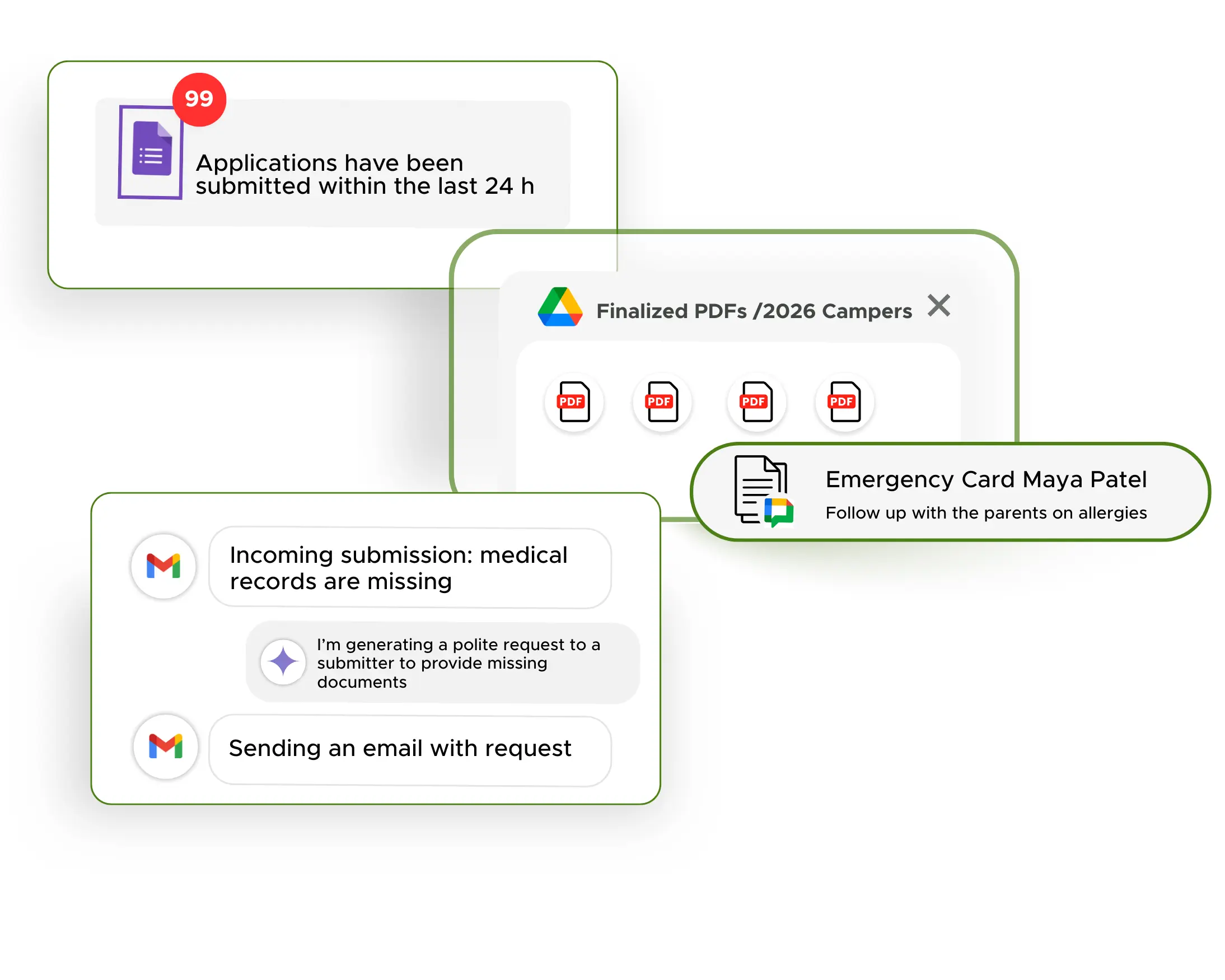


A Deterministic AI Agent is an AI-enabled system whose execution path, outcomes, and side effects are explicitly defined, auditable, and reproducible — even when probabilistic AI models are used within the process.
AI assists, but does not silently decide
Control flow is explicit and transparent
Exceptions are intentional paths, not surprises
Humans remain accountable

AI analyzes access requests, extracts context, and flags anomalies. Deterministic workflows enforce approvals, apply changes in Google Admin, and log every action.
AI classifies inbound emails and files, extracts key data, and assesses completeness. Workflows route requests, validate inputs, trigger follow-ups, and store outcomes with full traceability.
AI evaluates app usage, permissions, or requests against policy. Deterministic logic applies controls, escalates exceptions, and enforces security posture.
AI extracts invoice or request data and highlights discrepancies. Workflows control thresholds, approvals, posting, and audit records end to end.
AI analyzes inbound contracts or legal documents from Gmail or Drive, extracting key clauses, renewal dates, risk indicators, and missing information.
AI reviews onboarding or offboarding requests, extracts role details, department context, and access requirements from forms or emails.
With Zenphi execution paths are explicit. Permissions are role-based. Approvals are enforced, not implied. Every action is logged and traceable. Outcomes can be reviewed, replayed, and explained.
Yes. AI can generate insights, recommendations, and classifications. What is deterministic is how those outputs are used.
No. It removes uncertainty. Deterministic systems scale faster because they are predictable, governable, and trusted.
Yes. Zenphi supports AI models as bounded components within workflows.
Workflows can route low-confidence outcomes to review, escalation, or fallback paths by design.
No. Deterministic AI Agents combine AI intelligence with explicit orchestration — something traditional automation lacks.
No. Zenphi makes human accountability explicit and enforceable.
