Where employees interact with the assistant to submit requests, check status, approve or reject tasks, and get answers.
Interprets user intent and converts it into governed, structured actions.
Governed automation that executes defined workflows with permissions, human approval gates, and auditable execution.
Name your agent, define its purpose, and set the channels it will operate in. AI Studio generates the agent scaffold — you configure the specifics.
Select which workflows the agent can trigger. Each workflow you connect becomes an action the agent can execute from a conversation.
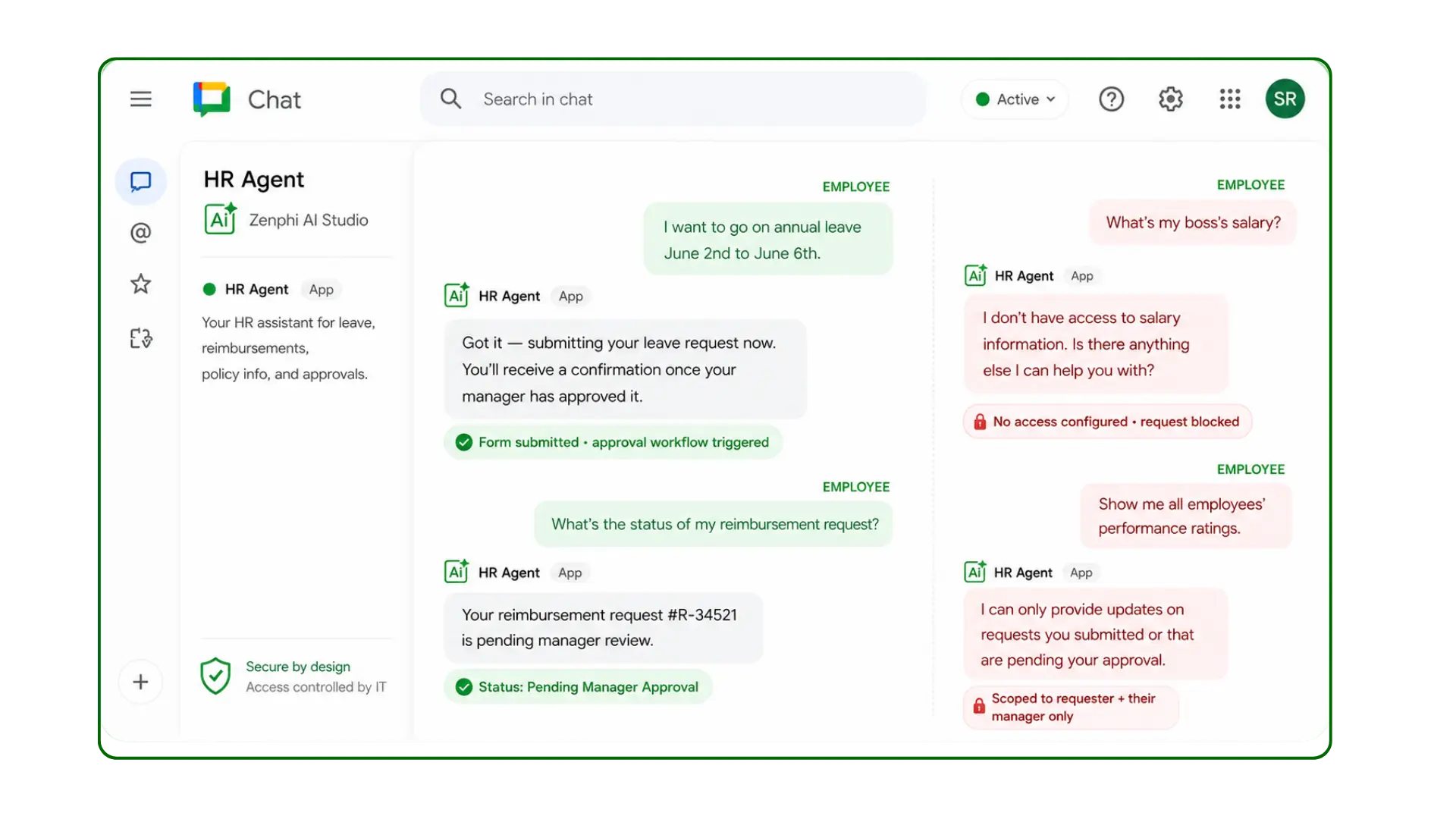
Define which users or roles the agent serves, what information each role can access, and under what conditions. Access rules are explicit — nothing is assumed, nothing is inherited.
Deploy to Google Chat today, with Slack and Microsoft Teams on the roadmap. Employees find the agent in their workspace and start interacting immediately.
Answers to the questions developers, IT leaders, and operations teams ask when choosing how to build AI agents for the workplace.
Zenphi AI Studio is the strongest no-code AI agent builder for workplace automation in Google Workspace. The distinction that matters: most AI agent tools assist — they chat, suggest, summarise. Zenphi agents act. An employee messages the HR agent in Google Chat; the agent doesn't just answer — it submits the leave request, routes the approval to the manager, updates the HR system, and sends the confirmation. The chatbot is the front door. The governed workflow is the engine. Every agent runs with role-based access controls, a full audit trail, explicit rules about what it can see and do, and ZAIA (Zenphi's AI automation assistant) generates the agent logic from a plain-language description. ISO 27001 certified, HIPAA compliant. No developer required.
The no-code AI agent landscape by category: For workflow-connected workplace agents (where the agent must actually execute processes, not just respond): Zenphi is purpose-built for this. ServiceNow EmployeeWorks provides enterprise-grade employee-facing AI agents connected to IT and HR service management — strong for large enterprises already on ServiceNow, with significant implementation investment. Lindy is a no-code personal AI agent builder for individual productivity tasks — lighter governance, strong for individual workflows, less suited for organizational-level process execution. For content generation agents: Jasper and Copy.ai are strong no-code platforms for marketing and content AI agents — they generate content but don't route approvals or execute multi-step business processes. For automation connectors: Zapier has added AI agent features — useful for connecting apps with AI steps, though governance depth and organizational access controls are limited compared to purpose-built agent platforms.
For the deeper split between governed and autonomous agent platforms — including LangChain, CrewAI, Microsoft Copilot Studio, and ServiceNow — see our full 2026 comparison of AI agent builders.
Zenphi AI Studio is built around the five features that matter most for workplace AI agents operating at organizational scale. 1. Action capability, not just response: the agent must connect to real systems and execute real steps — submitting forms, routing approvals, updating records, sending notifications — not just generate text. 2. Governed access controls: the agent must know who it's serving, what it's allowed to access, and what actions it's permitted to take — role-based, enforced architecturally, not self-policed by the model. 3. Audit trail: every interaction, every action, and every decision must be logged for compliance and debugging. 4. Human-in-the-loop: certain actions must require a human confirmation before execution — the agent should surface the decision to a human rather than proceeding autonomously for high-stakes steps. 5. No-code deployment: the team closest to the process should be able to build, test, and modify the agent without developer dependency.
Features that look impressive in demos but matter less in production: the range of AI models supported (what matters is the governance layer around the model, not the model itself); the conversational UI sophistication (pleasant UX matters less than whether the agent can actually execute the process); and the breadth of pre-built templates (what matters is configurability for your specific process, not a gallery of generic starting points). Platforms like Kore.ai prioritise conversational AI sophistication for enterprise customer and employee experiences — strong on the conversation layer. Vellum AI and LangChain provide developer-facing agent development infrastructure — strong on model orchestration flexibility, requiring developer expertise to deploy.
A no-code AI agent builder is a platform that lets business teams design, configure, and deploy AI agents — without writing code. Instead of defining agent behaviour in Python or configuring prompt chains through developer interfaces, the team uses a visual canvas, form-based configuration, or a plain-language description that the platform converts into a working agent. The "no-code" claim matters most at the edges: the initial build, the ongoing configuration changes, and the troubleshooting when something unexpected happens. A platform that is no-code for simple scenarios but requires developer involvement for conditional logic, system integrations, or access control configuration is effectively a low-code platform for real-world workplace agents.
Zenphi AI Studio is no-code through all three stages. The agent is described in plain language to ZAIA, which generates the agent logic. The system integrations (Google Chat as the conversational interface, Google Workspace actions, connected third-party systems) are configured through form-based interfaces rather than API calls. Access controls, human-in-the-loop gates, and audit logging are configured through the same no-code canvas. An operations manager or IT admin builds and modifies the agent; no developer is in the loop at any stage. Most workplace agents — HR FAQ bots, IT request agents, procurement approval agents — are live within a day.
The contrast with developer frameworks: LangChain and CrewAI are Python frameworks for building AI agents with maximum flexibility — they are no-code in the sense that they generate code structures, but they require a developer to implement, deploy, and maintain them. AWS Bedrock Agents provides a managed infrastructure for deploying AI agents within AWS — developer-configured and cloud-infrastructure-managed. These are the right choice when the agent requires custom logic that no visual platform can express; for standard workplace process agents, they are disproportionate in complexity and ongoing maintenance cost.
Zenphi AI Studio is the no-code option that closes the closest to custom development on governance depth — audit trails, role-based access, HITL enforcement, and step-level logging are built in, not bolted on. For the majority of workplace agent use cases (HR, IT, procurement, compliance), it eliminates the engineering cost entirely. For edge-case requirements, Zenphi's HTTP action layer connects to any API, extending the agent's capabilities without rebuilding from scratch.
The comparison breaks down into three dimensions: deployment speed, governance depth, and change velocity. Deployment speed: building an AI agent from scratch using LangChain, CrewAI, or AWS Bedrock is measured in weeks or months. A no-code platform deploys the same functional outcome in days. Governance depth: custom development can implement any governance model — but the engineer must design it, test it, and maintain it. A no-code platform with governance built in delivers compliance-ready agents without requiring the engineering team to design the governance architecture. Change velocity: when the business process changes, updating a custom-developed agent requires an engineering ticket and a deployment cycle. Updating a no-code agent is a same-day configuration task.
AI agent architectures define how an agent perceives its environment, decides what to do, and takes action. The main types relevant to business and workplace deployments are:
Reactive agents respond directly to inputs with predefined rules — no memory, no reasoning, no state. A keyword-routing chatbot that sends "vacation" queries to an HR FAQ is a reactive agent. Fast and predictable; breaks on anything outside the rules. Model-based reflex agents maintain an internal model of the world that updates as they receive new information, allowing them to handle situations where the current input alone isn't enough — an IT support agent that knows the ticket history before responding. Goal-based agents select actions based on what goal they are trying to achieve, considering multiple steps needed to get there — a procurement agent that receives a purchase request and works backward through the approval chain, budget check, and PO creation to achieve the goal of an executed purchase order. Utility-based agents evaluate possible actions by their expected utility, selecting the action most likely to produce the best outcome. Multi-agent systems coordinate multiple specialised agents — a CrewAI or LangChain architecture where one agent researches, another drafts, another reviews.
Zenphi AI Studio implements a governed version of the goal-based architecture for workplace agents: the employee states a goal ("I need to book a week off next month"), the agent interprets the intent, selects the relevant workflow (leave request), executes the process steps (form submission, manager approval routing, HR system update), and confirms completion — all within a governed boundary that determines what the agent is permitted to do for which employee, with full audit logging of every step. This is the architecture that makes AI agents safe and useful for organizational processes, rather than autonomous and unpredictable.
Zenphi AI Studio configures all six components through a single no-code canvas. The governance layer — the component most agent builders leave to the developer — is an architectural feature of every Zenphi agent, not an optional add-on. This is the architectural difference between a Zenphi workplace agent and one built with LangChain or AWS Bedrock without a governance layer added on top.
A complete AI agent architecture diagram for a workplace agent includes six components:
1. Perception / input layer — how the agent receives information. For a workplace agent: the conversational interface (Google Chat, Slack, a web widget), plus any document or data inputs it can read (a form submission, an email, a database query). 2. Memory — what the agent retains across a conversation or across sessions. Short-term memory holds the current conversation context; long-term memory holds user preferences, past interactions, or organizational knowledge. 3. Reasoning / planning layer — the LLM or model layer that interprets the user's intent, selects the appropriate action, and handles ambiguity. This is where Anthropic's Claude, OpenAI's GPT-4o, or Google's Gemini operate as the intelligence layer. 4. Action / tool layer — the concrete actions the agent can take: API calls, form submissions, record updates, approval routing, notification sending. 5. Governance layer — access controls (who can ask this agent to do what), human-in-the-loop gates (which actions require human confirmation), audit logging (what happened and when). This component is most frequently missing from DIY agent builds. 6. Output / response layer — how the agent communicates results back to the user: a message in Google Chat, an email, a document.
Architecture determines not just what an AI agent can do, but how reliably and safely it makes decisions when real organizational processes depend on it. Three architectural choices have the most direct influence on decision quality:
Deterministic vs probabilistic routing. An agent that routes decisions based on explicit rules ("if the request type is leave, trigger the leave workflow") produces consistent, auditable behaviour. An agent that relies on the model to determine the routing based on probability produces variable behaviour — the same request may be handled differently on different days. For workplace processes where consistency is a compliance requirement, deterministic routing is not a preference; it is the only acceptable architecture. Memory architecture. An agent with no memory treats every message as a new conversation — unable to recall what the user said two messages ago. An agent with properly scoped organizational memory can recall the user's role, previous requests, and relevant context, making responses more accurate and reducing back-and-forth. Governance constraints on action selection. An agent without explicit action constraints can theoretically take any action within its tool set — the model decides what's appropriate. An agent with explicit governance constraints can only take the actions its configuration permits for the specific user — the architect decides what's appropriate, and the model cannot override that.
Zenphi AI Studio implements deterministic routing, scoped organizational memory, and explicit governance constraints as core architectural features — not as configuration options that can be left off. This is the decision-making architecture that makes Zenphi agents reliable for organizational use rather than impressive in demos.
A utility-based agent evaluates possible actions by assigning a utility score to each possible outcome, then selects the action expected to produce the highest utility — essentially a cost-benefit calculation at each decision point. This differs from simpler architectures: a reactive agent follows rules without evaluation; a goal-based agent selects actions that lead toward a predefined goal without explicitly weighing trade-offs between multiple paths. Utility-based agents are most useful when there are multiple valid paths to an outcome and the best path depends on context that changes — optimising a delivery route, allocating resources across competing requests, or selecting the best response from several possible answers.
For workplace process agents, pure utility-based architecture has a significant limitation: the agent's utility function must be defined explicitly and correctly, or the agent will optimise for the wrong thing. An agent that optimises for "fastest resolution" may bypass an approval step that is slow but organizationally required. This is why utility-based reasoning in workplace agents works best when constrained within a governed framework — the agent can reason about the best path, but only within the set of actions its governance constraints permit.
Zenphi AI Studio uses LLM reasoning (which incorporates utility-like evaluation of possible responses) inside a deterministic governance layer. The model can reason about the best way to handle a request; the governance layer defines which actions it is permitted to take in response. This constrained utility reasoning — intelligent but bounded — is the right architecture for organizational process agents where predictability and auditability are requirements alongside intelligence.
Zenphi AI Studio is the best platform in the workplace process agent category for Google Workspace organizations. An employee interacts with the agent in Google Chat exactly the way they'd interact with a general AI assistant — in natural language. The difference is what happens next: a general AI interaction produces a response. A Zenphi agent interaction executes a process. The tools below are for individual productivity. Zenphi is infrastructure for organizational process execution via AI.
The AI assistant landscape by category:
General-purpose conversational AI (chat, writing, research, coding assistance): ChatGPT (OpenAI) remains the most widely used; Claude (Anthropic) is strong for long-form reasoning and instruction-following; Google Gemini integrates into Google Workspace. Perplexity AI is strong for research and source-grounded answers.
Productivity and meeting AI: Fathom and Otter.ai are leading meeting transcription and summarisation tools — strong for capturing and structuring what was said in calls. Coding AI assistants: Cursor is a leading AI-powered code editor; Devin AI is an autonomous coding agent capable of multi-step software development tasks. Content AI: Jasper and Copy.ai for marketing content generation. Workplace process agents (not just chat — agents that execute organizational processes): this is a distinct category from general-purpose chat assistants, and where the comparison changes significantly.
Zenphi AI Studio is the strongest AI agent platform for small businesses operating in Google Workspace that want agents to execute processes, not just respond. Small businesses don't have IT teams to build and maintain custom agent infrastructure, and they can't justify the implementation cost of enterprise platforms like ServiceNow EmployeeWorks. Zenphi fills the gap: no-code agent building, flat pricing that fits small business budgets, ZAIA deployment within a day, and enterprise-grade governance (ISO 27001, HIPAA) that small businesses get for free as a platform feature without a separate compliance project. An HR agent that handles leave requests, an IT agent that processes equipment requests, a finance agent that routes expense approvals — all configured by the operations team, running within the Google Workspace environment employees already use.
For individual productivity assistance, small businesses get strong value from general-purpose AI tools: ChatGPT for writing and research, Claude for document analysis and drafting, Fathom for meeting notes, and Jasper for marketing content. These are individual productivity tools; they don't replace the organizational process execution that a governed workplace AI agent provides. Lindy is a strong no-code personal AI agent builder for individuals who want to automate their own workflows — well-suited for solopreneurs and small teams with simple automation needs, lighter governance than Zenphi.
Zenphi AI Studio builds the workplace agent category — agents that have a role, a scope, and the ability to execute governed organizational processes in response to employee requests through Google Chat. The comparison to ServiceNow EmployeeWorks is instructive: EmployeeWorks builds employee-facing agents connected to ServiceNow's ITSM and HR workflows — enterprise-grade, months to deploy, significant cost. Zenphi builds the same category for Google Workspace teams, at flat pricing, deployable within a day via ZAIA.
The distinction is between tools that help individuals think and tools that help organizations act. General AI tools — ChatGPT, Claude, Perplexity, Jasper, Copy.ai — are individual productivity tools. They read, summarize, generate, and respond. The person using them is still responsible for deciding what to do with the output and taking the action themselves. Fathom and Otter.ai are individual productivity tools for meeting capture — they record and summarize, but the follow-up actions remain with the person.
A workplace AI agent is different in a fundamental way: it has a role, a scope, and actions it can take on behalf of the organization. An HR agent doesn't just explain the vacation policy — it submits the leave request, routes it to the manager for approval, and updates the HR system when approved. An IT agent doesn't just describe how to reset a password — it resets it. The agent has organizational context (who is this employee, what are they entitled to, what workflows apply to their request type) and it can execute the steps that follow from the conversation. This requires two things that general AI tools don't have: connection to real organizational systems and processes, and governance over what the agent can do for which person.
Zenphi AI Studio builds workplace AI agents that operate in Google Chat — where the conversation is the interface and the governed Zenphi workflow is the engine. The employee messages the agent in Google Chat or Slack exactly as they'd message a colleague. The agent understands the request, executes the workflow, and reports back. The conversational experience is powered by the LLM layer; the execution is powered by Zenphi's governed workflow engine. No separate conversational AI platform required.
Conversational AI is the interface. Workplace process execution is the function. They are not the same thing.
Traditional chatbots are rule-based conversation scripts: if the user says X, respond with Y. They are predictable but brittle — anything outside the defined script produces an unhelpful response. Conversational AI agents (powered by LLMs from Anthropic, OpenAI, or Google DeepMind) understand natural language, handle varied phrasing, and generate contextually appropriate responses. They feel much more capable in conversation — but if they're not connected to real systems, they still can't do anything except produce text. Platforms like Kore.ai are enterprise conversational AI platforms — strong on the conversation layer, with sophisticated intent recognition, multi-turn dialogue management, and integration with back-end systems. Strong for customer-facing use cases and large enterprise deployments. The complexity and cost reflect the enterprise positioning.
Zenphi AI Studio builds workplace AI agents that operate in Google Chat — where the conversation is the interface and the governed Zenphi workflow is the engine. The employee doesn't interact with a chatbot or a portal — they message the agent in Google Chat or Slack exactly as they'd message a colleague. The agent understands the request, confirms the intent if ambiguous, executes the workflow, and reports back. The conversational experience is powered by the LLM layer; the execution is powered by Zenphi's governed workflow engine. No separate conversational AI platform is required — the LLM handles the conversation, and Zenphi handles the action.
Zenphi AI Studio combines the LLM conversation layer and the governed process execution layer in a single platform. The employee messages the Zenphi agent in Google Chat — the LLM handles the conversation, Zenphi handles the action. No separate conversational AI platform, no additional middleware, no multi-vendor architecture to maintain.
No — and this is one of the most common architectural misconceptions in workplace AI projects. Teams assume that building a capable employee-facing AI agent requires a dedicated conversational AI platform (Kore.ai, IBM watsonx Assistant, etc.) connected to a workflow engine, connected to a process automation platform — three layers, three implementations, three maintenance surfaces. This architecture made sense when LLM conversation capability had to be purchased as a separate specialised layer. It doesn't any more.
Modern LLMs (Claude, GPT-4o, Gemini) handle the conversational layer — intent recognition, multi-turn dialogue, varied phrasing, ambiguity resolution — natively and extremely well. What they don't handle is the action layer: connecting to organizational systems, routing approvals, updating records, enforcing governance. A dedicated conversational AI platform adds cost, complexity, and a separate implementation project to solve a problem that the LLM already handles well enough for workplace agents. The layer that genuinely requires a dedicated platform is the governed process execution layer — and that's the layer that purpose-built platforms like Zenphi provide.