










[Free eBook] How To Setup AI Agents In Google Workspace Code-Free

n8n Alternative
Achieve More with Automation You Can Trust at Scale

n8n helps teams experiment and build powerful automations. Zenphi enables organizations to run business-critical processes reliably — with governance, clarity, and shared ownership built in.

Emerson
GFS
Google
Academies Trust
NYC
Default Title
Default Title
Default Title
Default Title
Default Title
Default Title
Default Title

Zenphi: A Governance-First Alternative to 8n8

From Experimentation to Operational Automation

n8n is an excellent tool for experimentation, custom integrations, and developer-owned workflows. It shines when flexibility and speed of prototyping matter most.

Zenphi is built for a different stage of maturity — when automation becomes operational, visible across teams, and accountable over time. It replaces ad-hoc logic with structured processes that non-developers can understand, review, and safely own.
faster end-to-end automation lifecycle from design to production
reduction in operational errors caused by manual handoffs
faster onboarding of new automation owners without developer dependency

Built for Teams

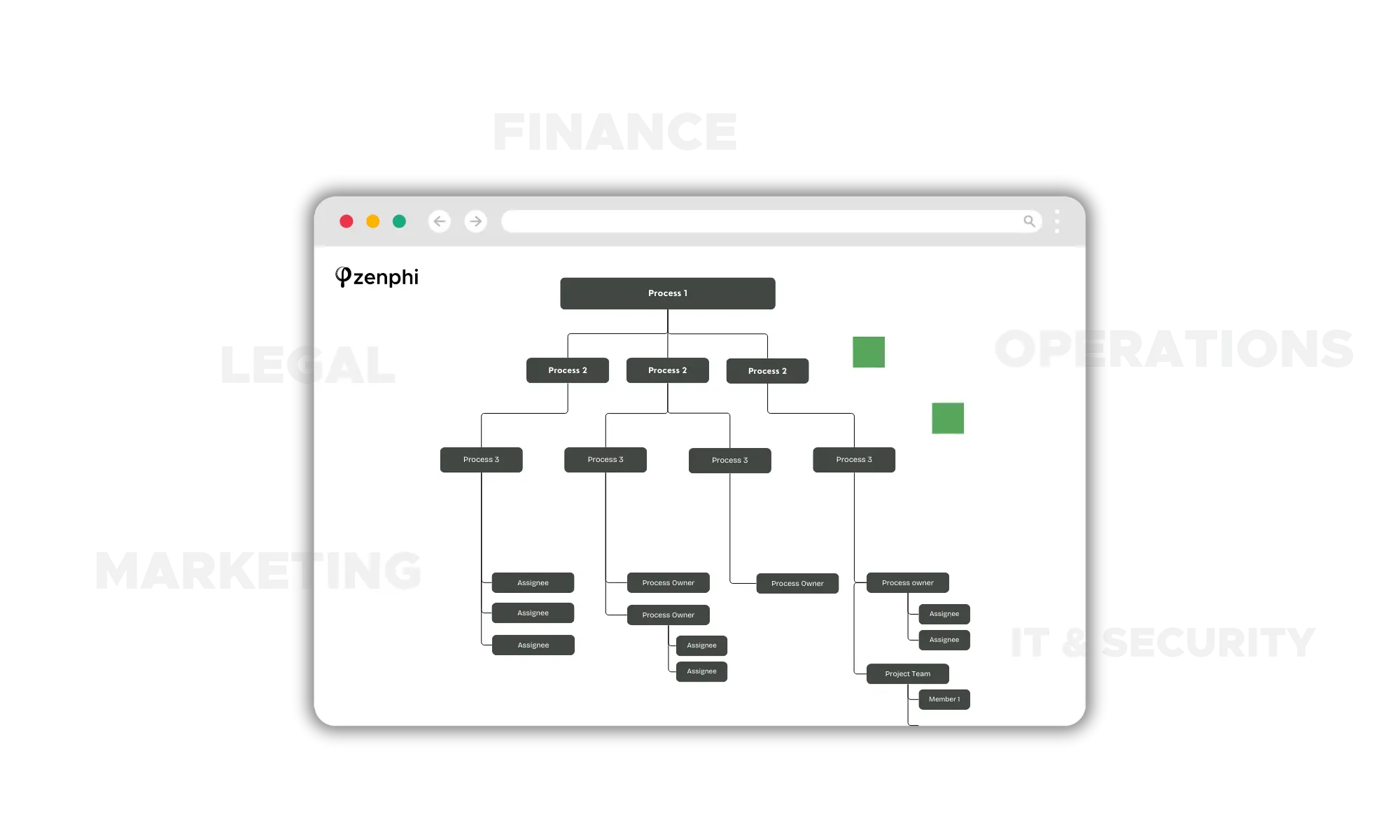
Zenphi workflows are designed for shared ownership, handover, and long-term maintenance. Anyone with the right role can understand what a process does and why.

Process-First

Zenphi workflows read like business processes, using actions and language aligned with real operations.

Governance by Design

Zenphi includes audit trails, approvals, versioning, and role-based controls natively.

Deterministic AI with Guardrails

Zenphi ensures AI-driven steps are traceable, reviewable, and controlled.
Built for Individual Developers

n8n assumes one or a few technical owners who are comfortable debugging logic and expressions

Code-First (Visual)

n8n is visual, but still requires thinking in execution graphs, JSON, and expressions.

Manual Governance

With n8n, governance is possible — but typically requires custom implementation and strict discipline.

Flexible AI Logic

n8n offers flexibility for AI experimentation, but production-grade safeguards must be built and maintained manually.
Why Organizations Move Critical Automation to Zenphi

Not for more power — but for less risk, less friction, and clearer ownership.
True No-Code
Zenphi does not ask ops teams to think like developers. No JSON. No expressions. No execution graphs. Logic remain readable months or years later.
Buit For Google
Zenphi is built for Google Workspace — meaning, deep alignment with Google’s security model, and native support for Gmail, Drive, Sheets, Admin & more
Deterministic Execution
Zenphi ensures predictable outcomes and human-in-the-loop approvals. AI enhances processes — it does not obscure accountability.

How Teams Use Zenphi for Governance-First Process Automation

Finance Operations
IT Operations
Recruiting & Hiring
Legal Operations
Customer Support
Cross-Department

Designed for Long-Running, Stateful Processes

Unlike n8n — an excellent tool for experimentation — Zenphi handles workflows that span days, weeks, or months — with visibility, checkpoints, and recovery built in. No brittle chains. No silent failures. Zenphi comes into play when you already know which automations can remain experimental — and which ones must be trusted at scale.

ZAIA — Your AI Workflow Assistant

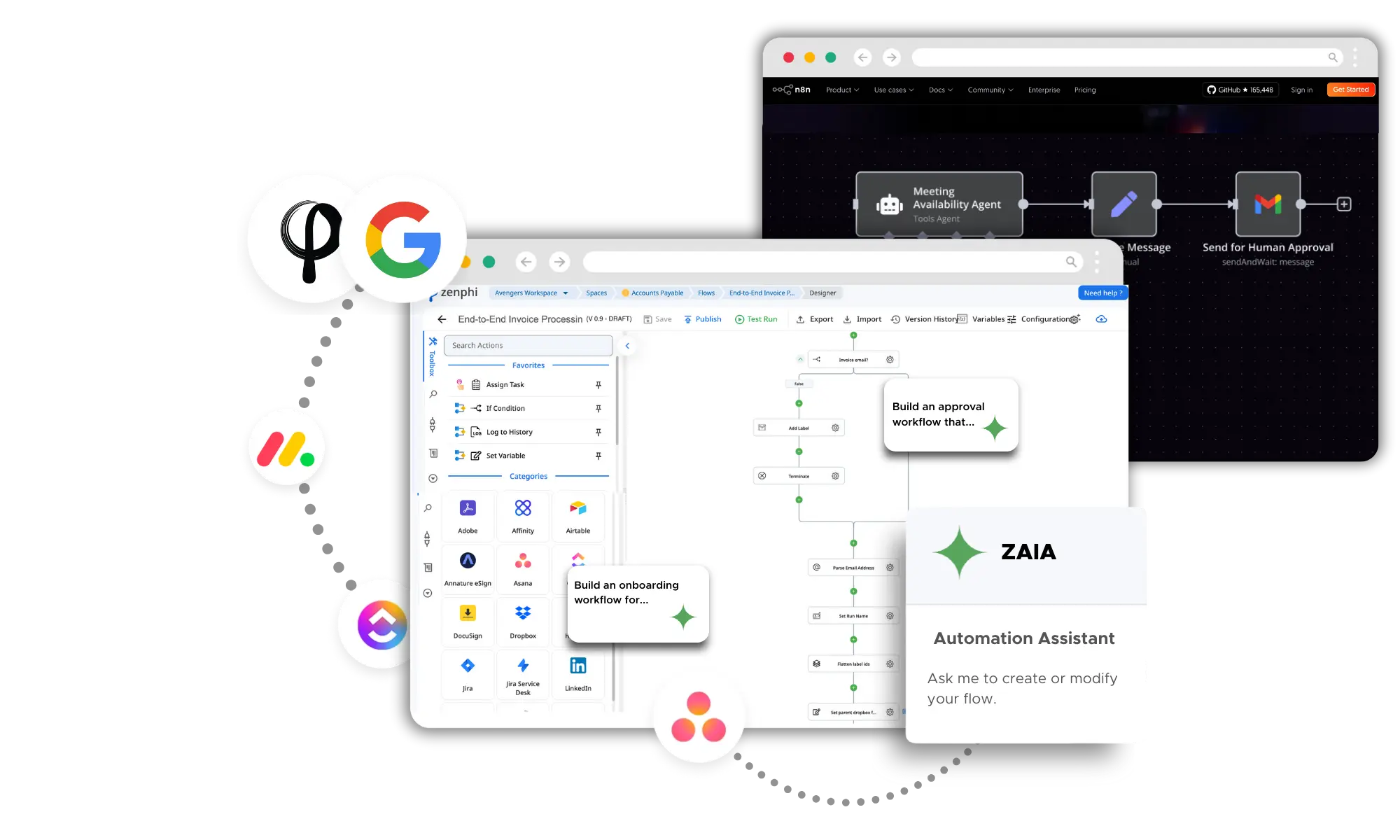
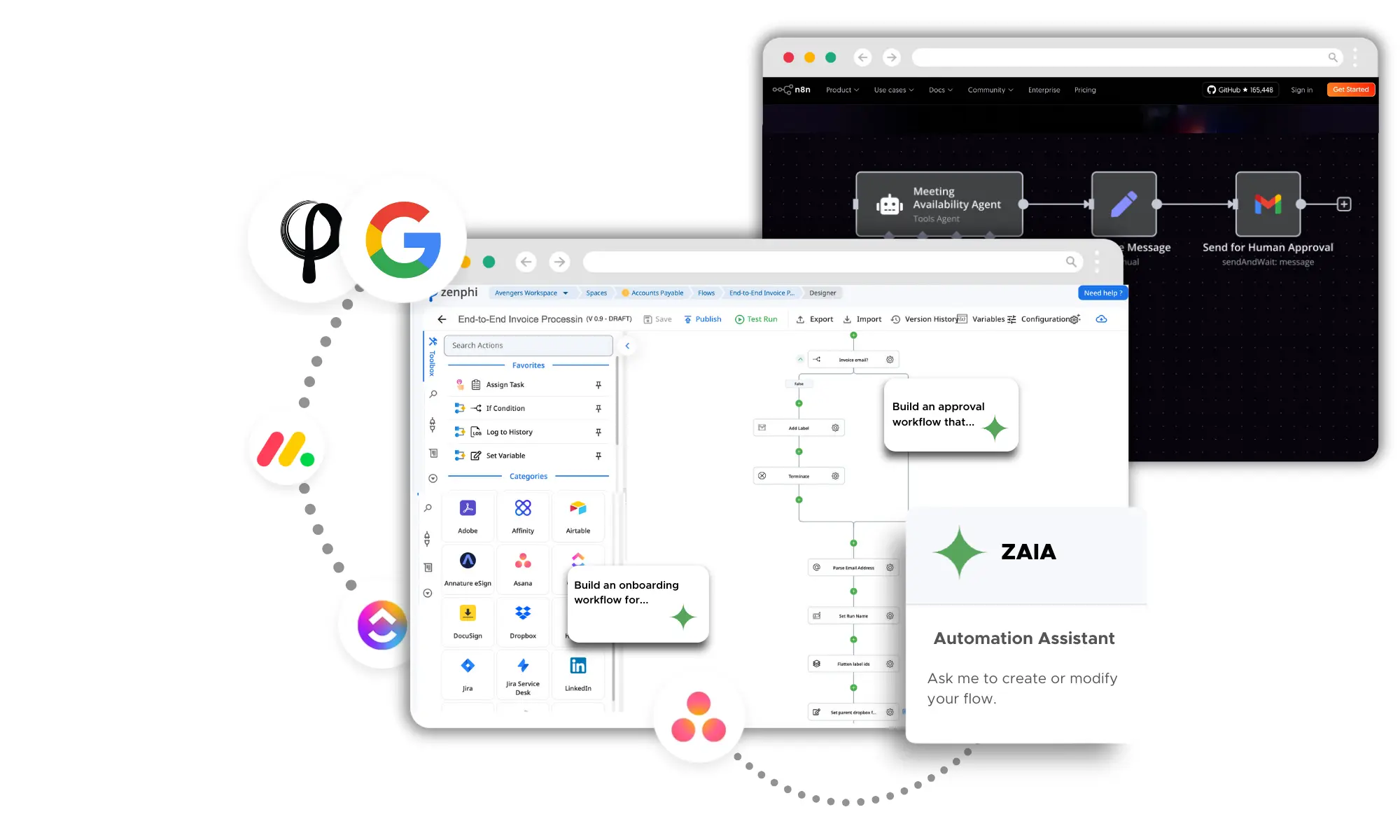
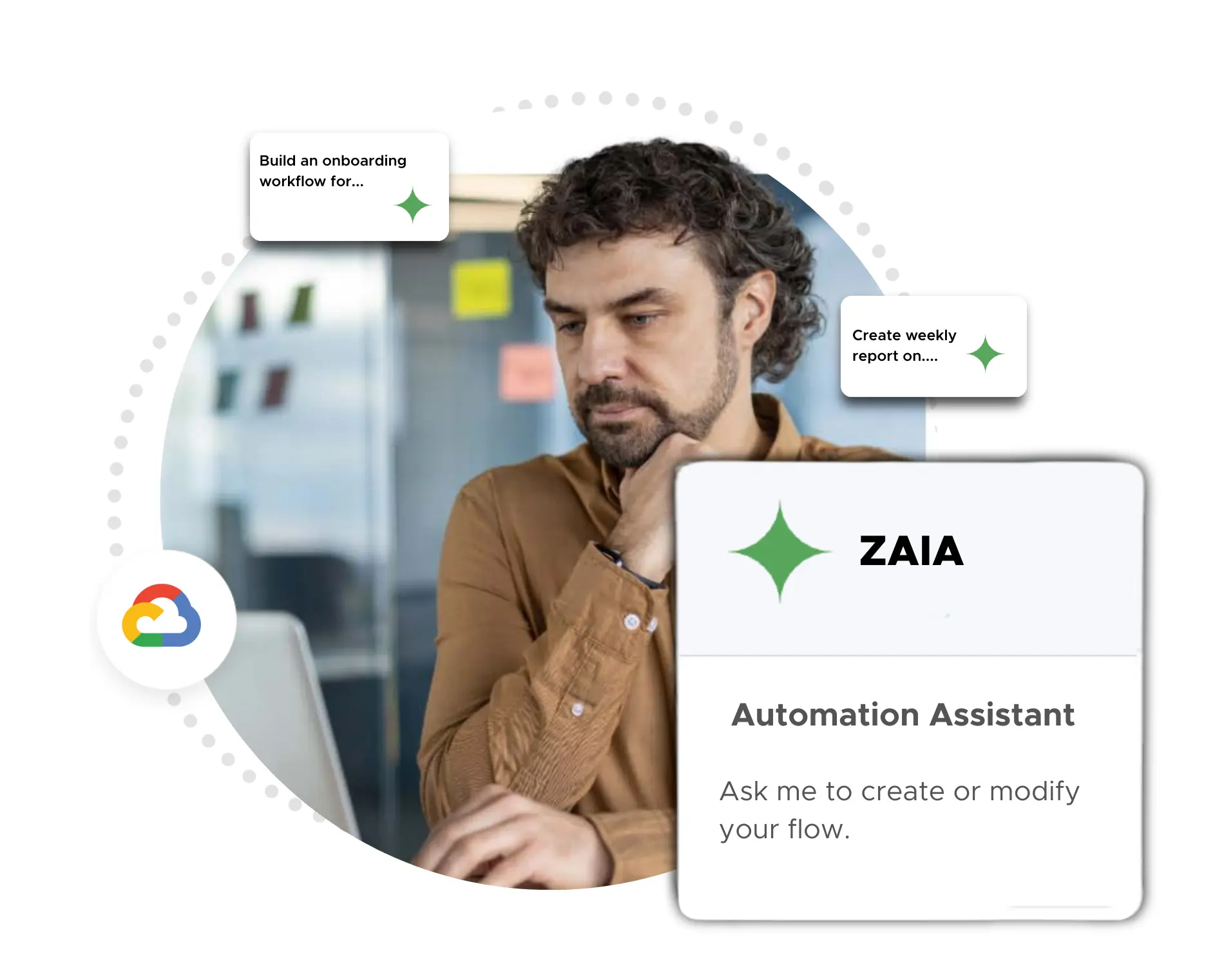
ZAIA is Zenphi’s AI-powered assistant that helps teams build workflows faster and with more confidence. Describe a process in plain English, and ZAIA generates a structured automation framework you can refine in minutes. ZAIA is not the intelligence running inside your operations — it is the smarter interface that helps you design, document, and manage them.

Human Support, When Automation Is Business-Critical

n8n is primarily supported through its community, documentation, and self-service resources. That works well for developer-led experimentation, where teams are comfortable troubleshooting issues independently.

Zenphi takes a different approach.

Zenphi provides direct human support from experienced automation and customer success engineers. There are no chatbots acting as gatekeepers and no reliance on community threads to resolve production issues. When you reach out, you work with someone who understands your workflows and can help you move forward quickly.

Why Customers Love Us

Real Results, Proven Success: Why Teams Trust Zenphi for Their Automation Needs

The Most Reliable n8n Alternative for Business-Critical Automation

From AI-powered document processing and approvals to end-to-end workflow orchestration, Zenphi delivers enterprise automation without operational risk. Built for Google Workspace. Designed for teams. Trusted by both IT and operations leaders.
FAQ

Zenphi does not rely on static templates in the same way n8n does. n8n templates are designed to help developers get started quickly with examples that they then customize and extend.

Zenphi takes a different approach: instead of starting from predefined logic, workflows are built to reflect your best practices and your existing business processes — but with governance, roles, and predictable outcomes from the start.

This helps avoid workflows that started as experiments and MVPs but ended up running critical processes without proper governance and control in place.

Not necessarily.

Many teams continue to use n8n templates for experimentation, proofs of concept, and developer-led exploration. Zenphi typically becomes the system of record for workflows that impact compliance, customers, security, or revenue.

The two tools often coexist — serving different stages of automation maturity.

Zenphi does include templates, but they are intentionally limited.

We believe your business processes are a competitive advantage — especially now, when most companies have access to the same tools, AI models, and integrations. Zenphi is designed to help you standardize what already works for your business, without forcing you into rigid, one-size-fits-all templates.

Templates in Zenphi are there to help teams get started and avoid the “blank canvas” problem. They provide practical starting points for common scenarios such as onboarding in Google Workspace, Google Admin task automation, document validation, AI-based CV screening, invoice processing, and more.

From there, teams build workflows using process-aware building blocks that map directly to real business actions — approvals, document handling, access changes, notifications, and integrations.

Zenphi also includes ZAIA, an AI-powered automation assistant that lets you describe a process in plain English and generate a structured automation framework in minutes. Instead of adapting a generic template, teams design workflows around their actual processes, rules, and governance needs.

n8n can run in production, especially when managed by experienced developers with strong operational discipline.

However, many teams find that additional effort is required to add governance, monitoring, documentation, and ownership clarity as workflows become critical. With Zenphi, all these items are handled from the start. The very first process automatin you built in Zenphi, would be 100% auditable, compliant, and deterministic — allowing humans to stay in control even where AI is used to classify, summarize, suggest and perform other supportive functions. 

Teams typically consider different categories of n8n alternatives, depending on their needs:

  • Developer-first automation tools (focused on flexibility and code-level control)

  • Integration and iPaaS tools (focused on connectivity)

  • Business process automation platforms (focused on governance and operations)

  • Workflow tools embedded inside specific ecosystems (e.g., Google Workspace)

Zenphi falls into the business process automation category, with a strong focus on Google Workspace–native, governed automation.

n8n is visual, but it still assumes a developer mindset. To use it safely at scale, teams need to understand execution paths, expressions, and error handling.

For non-technical teams or shared ownership models, this often becomes a bottleneck rather than an advantage. That’s where Zenphi is perfect — it allows non-technical users own the automations without burdening IT teams, and ge their fully functional workflows up and running in 48-72 hours. 

n8n is best used for developer-led automation, experimentation, and custom integrations. It works well when a small technical team owns the workflows and is comfortable working with expressions, execution graphs, and debugging logic.

Many teams use n8n to prototype ideas, connect niche systems, or experiment with AI before formalizing processes.

As automation matures and workflows become operational — supporting compliance, revenue, or security — teams often introduce a platform like Zenphi. Zenphi is designed to run those business-critical processes with clearer ownership, built-in governance, and workflows that non-developers can understand and maintain.

n8n can support approvals and human-in-the-loop steps, but they are not built in as first-class features. Teams typically implement approvals using conditional logic, custom workflows, or external tools, which increases complexity and maintenance over time.

This approach can work well in developer-owned environments where workflows are closely monitored and changes are carefully managed.

When approvals, reviews, and accountability become a core part of the process, teams often introduce Zenphi. Zenphi includes native, human-in-the-loop steps such as approvals, escalations, and review checkpoints, with full audit trails and clear ownership — without requiring custom logic or workarounds.