What top-level Google-certified partners, Workspace users and the Google team itself predict will be happening in 2026 security-wise
Table of Contents
In 2025, the cybersecurity landscape has entered a phase unlike anything we’ve seen in previous decades. AI-driven attacks are no longer speculative—they are becoming the default mode of operation for threat actors. There’s little doubt that it will become even worse in 2026. Breaches will not be rare events to prepare for; they will be recurring operational realities that Google Workspace administrators must anticipate, detect, and neutralize at machine speed.
For Google Admins, this shift elevates the role from system maintenance to strategic, continuous risk management. AI-enabled identity attacks, OAuth exploitation, deepfake-driven impersonation, autonomous agents probing your Workspace environment—all of these are emerging simultaneously. And the velocity of these threats is outpacing the speed at which manual admin work can respond.
Expert Insight: What Google, Workspace users, and Partners Are Seeing
These observations aren’t theoretical. Throughout 2025 we have been carrying out conversations with Google-certified partners like 66Degrees, CDW, Infosys, SHI Corp and many more, Workspace security architects, and frontline practitioners supporting global Workspace deployments. Across the board, these experts warn that AI-assisted attacks are accelerating faster than organizations can adapt, and that most native controls simply cannot keep pace with autonomous adversaries.
Google Cloud’s Cybersecurity Forecast amplifies this message. Senior leaders—including Sandra Joyce (VP, Google Threat Intelligence), Charles Carmakal (CTO at Mandiant, now part of Google Cloud), and Phil Venables (Google Cloud Strategic Security Advisor)—confirm that attackers already rely on AI to automate reconnaissance, generate deepfakes, craft weaponized phishing, assist with vulnerability discovery, and scale attacks across entire environments.
The same report highlights that security teams are entering an intermediate stage of semi-autonomous security operations, where defenders must rely heavily on automated workflows to triage alerts, reduce noise, and respond in seconds—not hours. Manual processes are no longer viable against machine-speed attackers. Some important facts this report reveals:
- The average time between vulnerability disclosure and exploitation dropped from 32 days to 5 days, and continues to accelerate
- Infostealers and credential theft campaigns surged in 2024 and will remain a leading threat vector in 2025 and 2026, routinely bypassing MFA and enabling high-impact breaches
The #1 Automation Solution For Google Workspace Admins
Zenphi is the must-have tool for Google Workspace Admins that enables your team to build granular automations, trigger processes from any event in Google Directory, Group, Workspace itself or Google Audit event, integrate your own scripts — all without the headache of debugging and maintaining code.
Account compromise is not just a Workspace problem—it is a systemic cloud security issue.
Google Cloud’s announcement of AI Protection further reinforces the urgency. Features like Model Armor (prompt/jailbreak protection), AI asset discovery, sensitive-data mapping for Vertex AI datasets, and AI-focused threat detectors exist because AI itself has become an attack surface. Shadow AI, data leakage from autonomous copilots/AI agents, and manipulated training data now require the same level of governance as any other high-risk system.
Google-certified partners we interviewed see the same trends inside Workspace environments:
OAuth escalation, unmanaged AI usage, identity spoofing, and agentic AI activity are becoming the fastest-growing blind spots.
Taken together, these insights point to a clear conclusion:
Automation—not manual admin effort—will determine whether organizations can maintain security in the AI-powered threat landscape of 2026.
Let’s look at all these aspects closely.
Why won’t native Google Workspace security be enough in 2026?
-
No AI Governance
Shadow AI activity cannot be tracked with native tools. Admins cannot see when employees, contractors, or autonomous copilots interact with sensitive data in unapproved ways.
-
Limited OAuth Risk Assessment
Incremental consent attacks—where malicious apps slowly escalate permissions—remain nearly invisible within native controls. In 2026, attackers will increasingly target admin consent flows using AI-assisted social engineering.
-
Insufficient Behavioral Analytics
Google Admin Console cannot differentiate between legitimate automated actions and autonomous attacker activity. AI agents can adjust their behavior in response to your defenses, blending into Workspace usage patterns.
-
MFA Bypass Blindness
Adversary-in-the-middle (AiTM) attacks remain highly effective against basic MFA. Native tools cannot detect subtle authentication context manipulation or session hijacking at scale.
-
Compliance Complexity
SOC 2, HIPAA, NIS2, and GDPR require continuous monitoring, evidence collection, and automated policy enforcement. Native audit logs lack the granularity and automation needed to maintain real-time compliance.
Want to explore this further?
Download The Google Cloud Cybersecurity Forecast-2026
Dive deeper into how operational weaknesses are being exploited—and what organizations need to prepare for next.
What should a 2026-ready Google Workspace security framework include?
What identity-first security controls Google Admins need in 2026
Modern identity protection requires automation:
- Phishing-resistant authentication for admin and privileged accounts
- Context-based access (device, location, IP reputation, behavioral fingerprints)
- Automated triggers when session context shifts
- Real-time detection and blocking of OAuth permission escalation
Zenphi — a must-have solution for Google Admins — allows your team to orchestrate user lifecycle management workflows, as well as identity workflows, enforce guardrails, and trigger immediate remediation based on risk signals.
How does AI-aware data protection work for Google Workspace
AI agents—including autonomous copilots—are becoming more and more helpful, and more popular within companies of all sizes. On the other hand, they also impose a major source of unintended data exposure.
Zenphi helps teams:
- Monitor access patterns from both humans and AI
- Enforce automated DLP actions
- Detect and block anomalous sharing behaviors
- Maintain an audit layer around AI-to-data interactions
- Implement dynamic, context-rich data policies
How should admins govern OAuth and monitor app behavior in 2026
OAuth is expected to remain the No. 1 attack vector in 2026.
Zenphi workflows can:
- Detect incremental permission increases
- Automate revocation and user verification flows
- Escalate high-risk app events to security channels
- Enforce approval-based governance
How can Google Admins detect and stop agentic AI attacks
Incoming threats include autonomous attack agents capable of reconnaissance, exploitation, and adaptive behavior.
Zenphi enables:
- Automated incident response
- Continuous correlation of AI-to-human interactions
- Real-time enforcement of Workspace guardrails
What does continuous compliance look like in 2026
Manual compliance work is not sustainable in an AI-threat environment.
Zenphi automates:
- Compliance posture checks
- Evidence collection
- Access reviews and deprovisioning
- Regulatory audit preparation
The Risks Targeting Google Workspace in 2026
-
What AI-powered attack techniques will target Google Workspace in 2026?
Threat actors now use AI for the entire attack lifecycle. Prompt injection can manipulate copilots into leaking data or executing unintended actions. Agentic AI removes previous barriers to entry—attackers no longer need deep technical expertise.
-
How will identity attacks and deepfake impersonation evolve in 2026?
Sophisticated identity replicas can impersonate executives in real time. This threat aligns with Google’s warning about escalating identity compromise and deepfake-enabled fraud.
-
Why will OAuth exploitation become a top threat in 2026?
AI-assisted consent phishing targets admin approvals and grows access gradually. Native tools cannot detect or contain this pattern early enough.
-
How will autonomous copilots create data leak risks?
By 2026, copilots may surpass human users as accidental sources of data exposure due to inherited permissions and complex access paths.
-
What should admins know about data poisoning and AI training risks?
Attackers are manipulating training data to embed hidden behaviors or degrade AI model trustworthiness. AI governance and automated monitoring are required to detect corruption early.
What does the latest industry data tell us about 2026 risks?
Industry intelligence is clear:
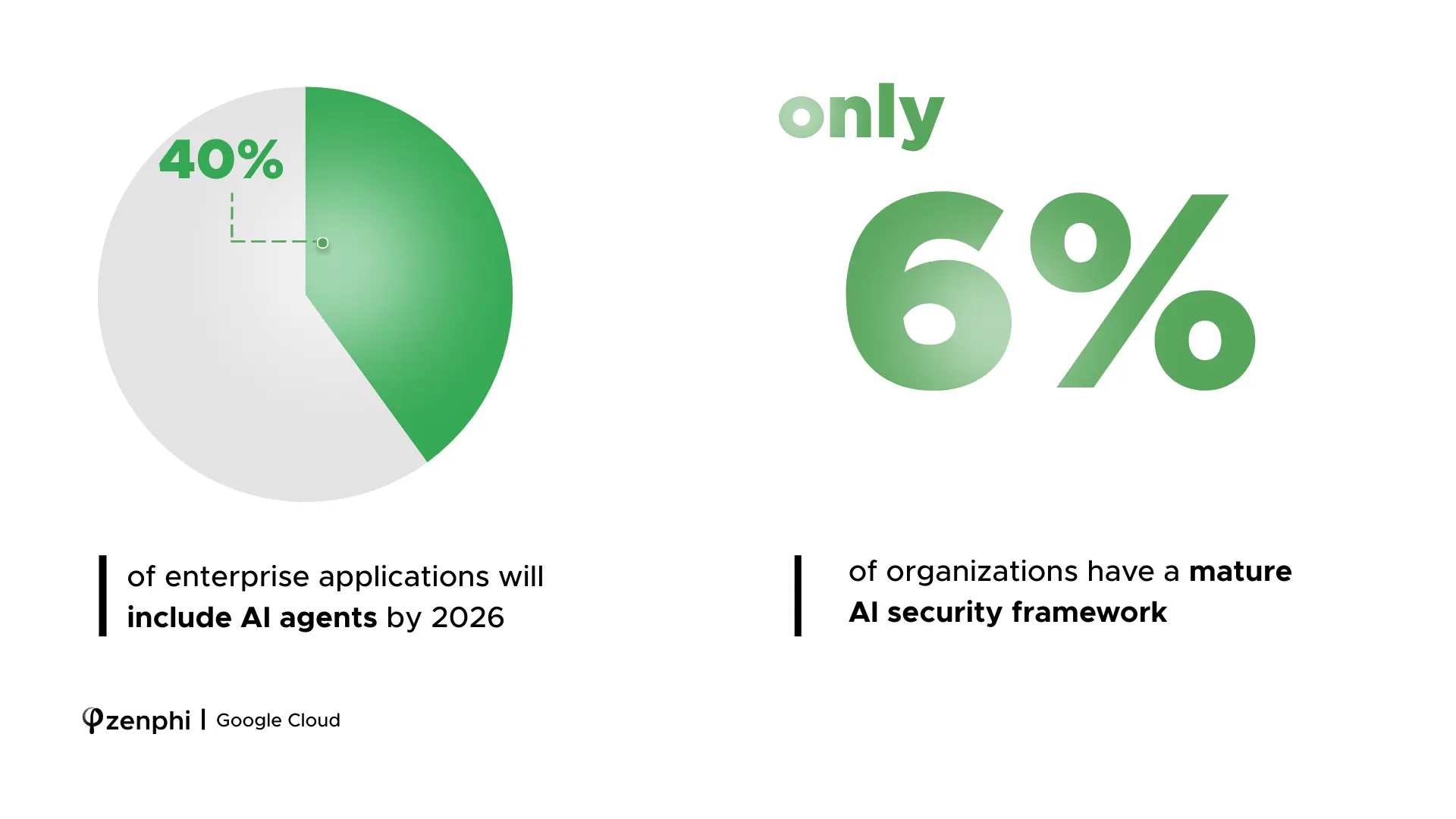
- Machine identities now outnumber human accounts 82:1
- Analysts expect the first major agentic AI–driven breach in 2026
- Autonomous copilots may surpass humans as the primary source of data leaks
In the same time, native Google Workspace tools cannot:
- Detect agentic AI behavior
- Monitor AI-to-AI interactions
- Identify synthetic identities
- Enforce continuous compliance
- Automatically contain permission escalation
The most expensive decision you can make in 2026 that will cost you a lot? Waiting too long to automate.
How can Zenphi help Google Admins prepare for 2026 threats?
Zenphi is not a cybersecurity tool. However — from onboarding, offboarding and data archiving, to file sharing audits, to access revokes — it provides the most elaborate in the market automation fabric Google Admins need to orchestrate identity, OAuth, DLP, compliance, and incident-response workflows across Workspace and external systems.
Zenphi enables teams to:
- Detect suspicious identity behavior and automate remediation
- Standardize offboarding, access cleanup, and periodic access reviews
- Build zero-touch incident response playbooks
- Continuously validate compliance policies
- Automatically detect and contain risky sharing or data exposure
- Integrate AI threat insights with Workspace-level actions
- Maintain real-time Workspace hygiene and posture
Automation is not optional in 2026—it is the control plane for Google Workspace security.
FAQ: Google Workspace Security Threats in 2026
What are the top threats?
AI-powered identity attacks, deepfake impersonation, OAuth exploitation, agentic AI reconnaissance, and data leaks from autonomous copilots.
How can Google Admins defend against AI-driven threats?
Adopt an identity-first model and use automation for DLP, OAuth governance, and incident response.
Why is AI governance essential?
Unmonitored AI agents can leak or modify sensitive data, manipulate user workflows, or corrupt training data.
Why is OAuth exploitation accelerating?
Attackers use AI-assisted consent phishing to escalate privileges gradually, bypassing traditional detection.
How does Zenphi help?
Zenphi automates continuous monitoring, onboarding and offboarding, identity governance, OAuth controls, compliance workflows, and incident response—enabling real-time defense at the speed AI attacks now operate.